This article was written on October 13, 2024.
The Colorado Avalanche have a problem, and the 2024-2025 National Hockey League Season is barely a week old.
There’s an old adage in the hockey community saying that the game should really be called goalie. When so much of a team’s success depends upon the skill of their netminder, it’s not hard to see why. They are a team’s literal last line of defense, and the best of them can carry otherwise mediocre teams to great success—see Dominik Hasek’s time with the Buffalo Sabres. In the words of former Sportsnet reporter Jeff Marek, if you have a goalie, it’s 70% of your team, and if you don’t, it’s 100%. Right now, the Colorado Avalanche are sitting at 100%.
Now—to clarify, the Avalanche have only played two games so far this season. They’ve lost both, but that happens! Last year’s Florida Panthers lost their first two games of the season, and they won the Stanley Cup. It’s entirely possible that they rebound from this, go on a tear, make some noise in the playoffs and maybe even secure their franchise’s fourth Stanley Cup.
But with that said, we need to talk about the Avalanche’s goalie situation.
Through two games, the Avalanche have lost 8-4 to the Vegas Golden Knights and 6-4 to the Columbus Blue Jackets. They’re scoring four goals per game, which is fantastic. They’re also allowing seven goals per game, which is horrific. Granted, two of those 14 goals were in an empty net situation, but even if you’re only counting goals scored on goalies, that still comes out to six goals allowed per game. Not even the best team in the NHL could win regularly while allowing six pucks into the back of their net every single game. I can say that with confidence because the Avalanche, in theory, are in the running for that esteemed title. They have last year’s League MVP in Nathan Mackinnon, the perennially underrated Mikko Rantanen, and the arguable best defenseman in the league in Cale Makar. They won it all in 2022, and many of their most important players during that title run are still on the team. The only position that has been completely revamped since then is goaltender.
In the summer of 2022, the Avalanche lost goaltender Darcy Kuemper in free agency. After winning the Cup with them that year, he was slated to be a more expensive player than they could afford, so they let him walk. This isn’t unprecedented in the least; free agent players coming off a Cup win always command more money than they otherwise would. Kuemper was serviceable for Colorado that year, but he wasn’t brilliant—he posted a .902 save percentage, which was under league average that year. (Save percentage is the most reliable non-advanced metric for evaluating goalies, so I will be using it from here on.) The Avalanche believed they could find a replacement level goalie elsewhere, and eventually acquired Alexandar Georgiev in a trade with the New York Rangers. Georgiev, who had a .908 overall save percentage with New York, was clearly capable of being more than a backup—he was just stuck playing behind Igor Shesterkin, who was voted the NHL’s best goalie in the 2021-22 season. Colorado believed in Georgiev, and in the 2022-23 season, he proved that they were right to do so. He had a career-best .918 save percentage, well above league average, and started 62 games, a workload nearly unheard of in the modern NHL. They were upset in the first round of the playoffs that year, but the future seemed bright.
In 2023-24, Georgiev started 62 games once again. He won 38, only dropping two from his total of 40 the previous year, but his play in those games dropped off in alarming fashion. His save percentage plummeted from that .918 to an .897, solidly below that year’s league average rate of .903. He remained iffy throughout the playoffs, most notably when he allowed seven goals in the first game of the postseason, and while he rebounded to a fantastic .931 for the remainder of the first round, the cracks were beginning to show. In the Avalanche’s second round matchup against the Stars, his save percentage sat at an .895, just a hair under his regular season average. Colorado was eliminated in six games, and entered the offseason with the beginnings of a question in net.
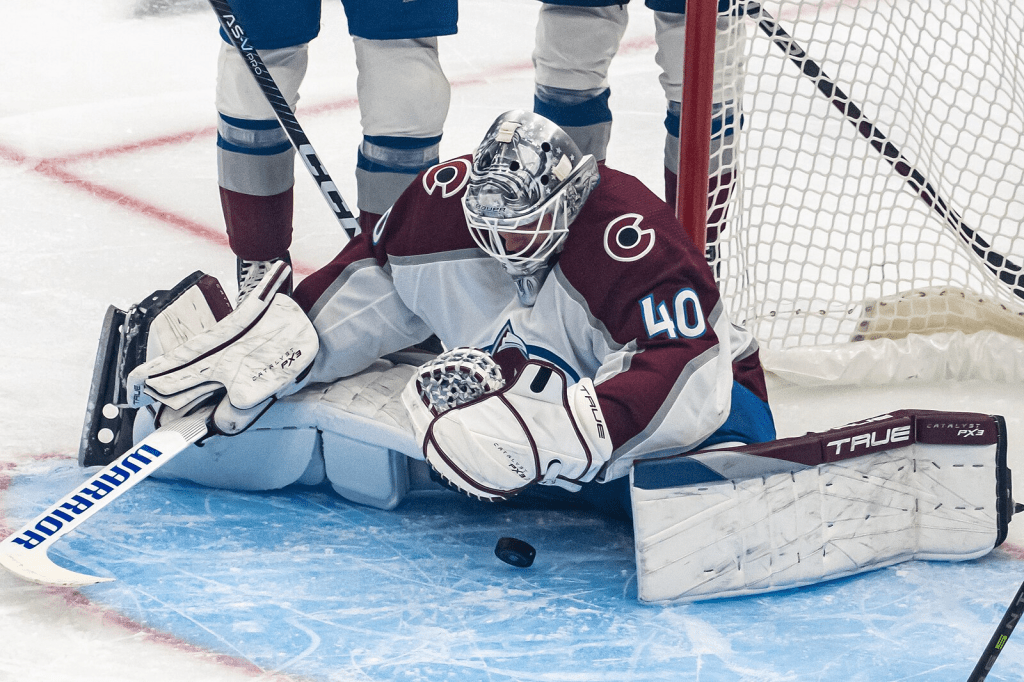
Fast forward to now. Georgiev has allowed eight total goals over two games this season, resulting in a save percentage of .680. He has started both games and has been lit up both times, once by a good team (Vegas) and once by a less good team (Columbus). I watched the highlights of the two games (Vegas, Columbus), and the situation is dire. There isn’t a specific place being targeted—Georgiev just isn’t making the saves. Yes, many of those plays involve defensive breakdowns. Yes, many of those shooters have some of the better shots in the league. But as the starting goaltender on an NHL team, your job is to stop the puck. In the words of longtime NHL head coach John Tortorella, “you need a [expletive] occasional save,” and when you’re allowing an average of four goals per game, it isn’t hard to see why detractors call you Fourgiev.
Again, we’re only two games into the season. It’s entirely possible that Georgiev overcomes whatever he’s dealing with, whether it’s a nagging injury or a mental block—but how long is that going to take? And how much time do the Avalanche have to spare?
I don’t know. I don’t have any answers. I can only hope that Colorado finds them soon, because we’re seeing what happens when you can’t stop the puck and everyone knows it.




 Box Turtle Arts Journal
Leave a comment